
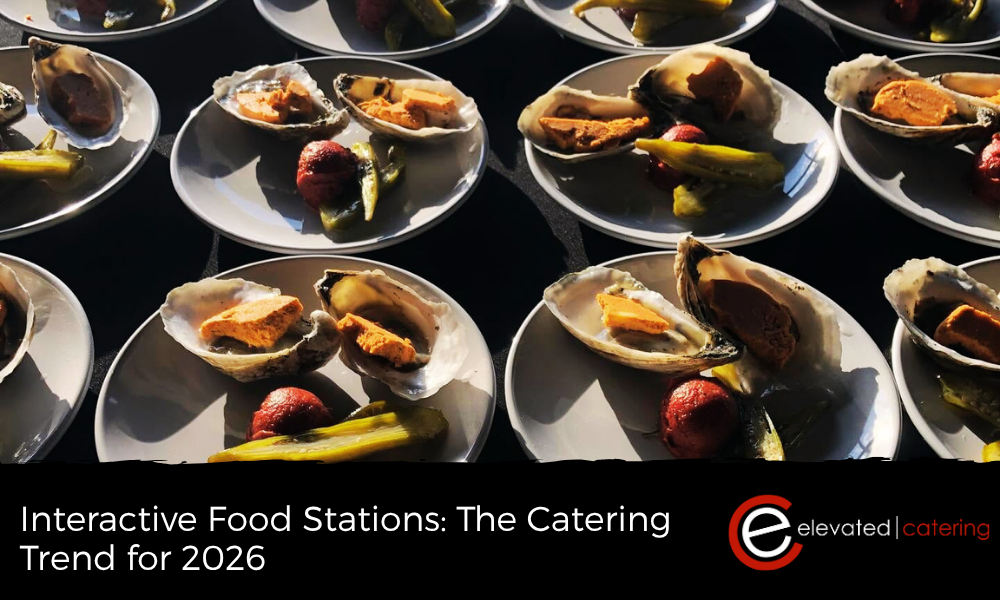
Interactive food stations are quickly becoming the centerpiece of weddings, corporate events, and celebrations across the Triad. They’re replacing the traditional buffet line as the go-to way to feed a crowd. Instead of filing past chafing dishes, guests move through live-action stations such as a raw bar, a taco bar, or a hand-tossed pasta station. Food gets prepared, finished, or plated right in front of them. At Elevated Catering Company, we’re seeing more 2026 clients ask for stations than ever before, and for good reason: they turn dinner into an experience guests remember long after the last course.
What Are Interactive Food Stations?
Interactive food stations are chef-attended serving setups where chefs cook, assemble, or finish dishes to order in front of guests, rather than pre-portioning them and setting them out under heat lamps. A guest might watch a chef sear scallops to order at a live sauté station, build their own bowl at a grain-and-protein bar, or pick their toppings for a wood-fired flatbread pulled straight from a portable oven. The common thread across every version is participation: guests make choices and watch the process, instead of simply serving themselves from a fixed spread. That shift, from passive to interactive, is exactly why the format has taken off.
The format also gives a caterer more room to show off range in a single event. A traditional buffet usually settles on one style of cuisine to keep the line moving. A room full of stations can hold a raw bar, a pasta station, and a taco bar side by side. Nothing gets confused, since each one has its own line, its own chef, and its own pace. For hosts, that variety is often the whole point — it lets a single event menu do more than one thing well.
Why Interactive Food Stations Are Replacing Traditional Buffets
A few forces are driving the shift away from a single buffet line. Most of them come down to what guests actually want out of an event today:
- Guest experience over guest service: A station turns a meal into a small performance — watching a chef flambé bananas foster or shuck oysters to order adds entertainment value a buffet line simply can’t match.
- Built-in dietary customization: With stations, guests build their own plate, which makes it far easier to navigate allergies, vegetarian or vegan preferences, and gluten-free requests without a separate “special diet” table.
- Shorter, smoother lines: Spreading guests across three or four stations instead of one buffet cuts wait times and prevents the bottleneck that happens when 150 guests queue for the same chafing dish.
- More shareable moments: Live cooking stations are inherently more photogenic than a buffet spread, which matters for hosts hoping their celebration gets talked about — and tagged — online.
Together, these reasons explain why more Triad couples and event planners are asking for stations by name when they sit down for a tasting.
Popular Interactive Station Ideas for Triad Events
Some of the stations we’re building into 2026 menus most often:
- Live pasta station with a choice of sauces tossed to order
- Raw bar with fresh-shucked oysters and chilled seafood
- Taco or street-food bar with build-your-own fillings and salsas
- Tableside dessert station — think flambé, cannoli building station, or a build-your-own s’mores bar
- Attended charcuterie and grazing display, refreshed throughout the event
- Craft cocktail or mocktail pairing station matched to the menu
Most of these can be scaled up for a 200-guest wedding or scaled down for an intimate rehearsal dinner — the format flexes to the guest count, which is part of what makes it work for so many types of events. For even more inspiration, WeddingWire’s roundup of food station ideas is a great place to browse
Traditional Buffets Still Have Their Place
Interactive stations aren’t the right fit for every event. A well-run traditional buffet is still a smart choice for very large guest counts, tighter budgets, or events where speed matters more than spectacle — like a 300-person corporate lunch on a tight hour-long window. Buffets also require less staffing per guest than a room full of attended stations, which keeps costs predictable for budget-conscious clients. The goal isn’t to declare one format the winner across the board; it’s matching the format to the guest count, budget, and pace of the day.
A buffet also gives guests more control over timing — they can go back for seconds whenever they’re ready, rather than waiting for a station’s line to clear. For events with a tight run-of-show, like a corporate lunch squeezed into a one-hour break, that flexibility can matter more than the novelty of a live station.
Blending Both: The Hybrid Approach
Many of our clients land somewhere in between: an anchor buffet or plated entrée covers the bulk of the meal, paired with one or two interactive stations — a raw bar during cocktail hour, a dessert station later in the night — to add a moment of spectacle without the cost or staffing of an all-station menu. It’s often the most practical way to get the best of both formats.
Cost and Planning Considerations
Let’s talk honestly about cost, because we always do with our couples: stations run a little more per guest than a comparable buffet. That’s simply because we’re putting more chefs and attendants in the room to staff each one throughout the night. Here’s the good news — you don’t have to go all-in. Most of our couples land on one or two stations paired with a plated dinner or a smaller buffet, which gives them that “wow” moment without stretching the budget. If you’re weighing it, here’s a good rule of thumb. The more you want your event to feel like an experience, the more a station or two earns its keep. Got a big guest list and a tight budget? We’ll help you get the same wow with a smart hybrid plan instead.
One thing we’ll always tell you upfront: book early if you want stations. Because we’re staffing and sourcing for each station individually, we like to lock those details in a few months out for a wedding. That way, we can line up the right equipment, ingredients, and kitchen crew without scrambling. If you’re eyeing a spring or summer date, let’s start that conversation sooner rather than later — those calendars fill up fast.
How Elevated Catering Company Brings Interactive Stations to Life
Every station we build starts the same way the rest of our menus do: with clean, locally sourced ingredients from Piedmont Triad farms, prepared with the same standards guests expect from a fully plated meal. For couples planning a wedding, we can build stations into any of our tiered wedding packages, and scale them up or down to fit the guest count and budget. For corporate clients and private events, we pair a station-style menu with our full catering services to create something that feels custom to the occasion, not pulled off a set list. And for clients who want the interactive-station experience on a smaller, more intimate scale, our Elevated Supper Club events are a great preview of what chef-attended, in-the-moment dining feels like.
Ready to swap the buffet line for something guests will actually talk about? Contact Elevated Catering Company today to start building a station-style menu for your next wedding, corporate event, or celebration.